


The Kennel Club
Henry Jennings | Marcus Today
Let’s face it, in the big scheme of things, the ASX is not exactly a happening place this year. So far, we are up a massive 0.2%. The Nasdaq is up 16%, and the KOSPI is flying, up 101%. You can see why some investors are turning their noses up at the ASX.
But before you write it off, remember that indices are a market of stocks. We do not have the tech behemoths that Korea or the US has. It is all a matter of perspective. If you were an American investor looking for turbocharged returns, you would probably be envious of Korea. We are just envious of pretty much everyone.
Given that our market is around 30% boring banks, it is understandable. The banks cannot really grow. We are a nation of 27m people. The banks are building societies on steroids. They not only have a banking licence, but they also have a social licence. There is a limit to how much they can gouge us.
To be fair, they give it their best shot and still make more than $30 billion in profits. Which year? Every year.
They pay fully franked dividends and, in our current, soon-to-be-upended tax environment, remain extremely attractive. Many retirees will never sell their banks. CBA will only be prised from cold, dead hands, as the NRA would say. The same applies to a number of other stocks, CSL and COH among them.
Yet 2026 has really been the year of the dogs. I do not think I have ever seen so many blue-chip stocks in The Kennel Club. It looks like Crufts in there. Supposed blue-chip after supposed blue-chip has been smashed this year as investors chased the silicon-chip frenzy.
What is always interesting is that analysts and brokers remain completely convinced about the valuations of some of these stocks, often maintaining price targets far above current prices. I have long been sceptical.
One stock I have spoken negatively about for the last year or so is RMD. Every broker and analyst I have discussed it with has been bullish and assured me I was wrong. Well, I am afraid, my friends, the share price does not lie. It has been on a one-way ticket to Disappointment Town.
Let’s run through a few of the dogs: IEL, TWE, WTC, JHX, CSL, COH, PME, SGP, JBH, SEK, REA, RMD, FLT, HVN. The list goes on.
In fact, when you consider the huge falls in these supposedly safe and dull stocks, it is frankly amazing that the market has managed to keep its head above water.
But I have often said this: you buy the US for tech, and you buy Australia for resources.
That is where the gains have come from. BHP up 38%, at record highs. PLS up 54%. S32 up 36%. MIN up 35%. RIO up 29%.
It is horses for courses. Resources are our thing. We do them well, and our market has held up because of it.
We know the AI and data-centre trade relies on supply chains and commodities. You cannot build a massive data centre without copper, concrete, steel and all the other things we happen to be very good at producing.
Perhaps, rather than blindly buying an ASX 200 ETF, it makes sense to separate some of our world-class growth stocks, which are, to some extent, masters of their own destiny.
I have never understood investors who ignore resources because they are "too volatile" and nobody knows where commodity prices will be in two years. Equally, nobody knows what an AI token will cost in two years. Nobody knows how much data centres will cost as labour and materials continue to blow out.
There are very few things you can predict with certainty.
At least with resource stocks, there is a transparent daily market. You know what a mining company or oil producer receives for its products. Better still, these companies can hedge, lock in high prices and secure margins. I am not sure the same can be said for much of the tech sector.
What transparency do we really have around WTC’s pricing of CargoWise, for instance? Unless you are a customer, you do not know what users are paying. We simply wait for the results and discover what revenue the company generated.
Passive investing is great. Following an index works over time. Compounding and low fees are powerful forces.
But you do not have to be a genius to pick a handful of resource winners and build your own ETF equivalent. Not only do you avoid ongoing management fees, but you also have a chance of outperforming.
One thing is absolutely certain. If you buy an ETF that passively follows an index, you will underperform that index. It may only be by a little, but the fees guarantee it.
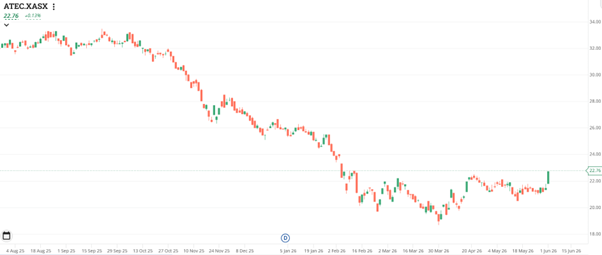
We are approaching the end of the financial year and the cusp of some significant changes over the next few years following the Budget measures. There is an old theory that the dogs of one year become the winners of the next.
We are starting to see signs of life in The Kennel Club.
Source: Marcus Today
The software stocks, pretty much all the tech sector we have, are stirring. They have all fallen a long way. XRO raised money to buy its US beau at $176. The share price is around $100 lower than those dizzy days.
WTC is now below $40. Hard to believe that when Richard White bought out his partner in December 2024, the stock was trading around $125. Maree Isaacs did very well. Timed it beautifully.
But before we write off the tech sector completely, it is not as though the results have been terrible or guidance has collapsed.
The reality is that a massive compression in P/E ratios has sent seismic shocks through the sector. Some of that can be attributed to higher interest rates, which affect DCF valuations. More importantly, though, sentiment has shifted.
When sentiment changes, P/Es can move from nosebleed levels to merely expensive levels, and that adjustment can be brutal, even when the underlying business continues to perform well. But just as PEs can contract, so PEs can expand. The money that has been chasing US and Asian AI stocks, semiconductors, and chips can easily find its way back into software stocks. That is something we are starting to see in the US and may be the first stirrings of that on the ASX. Sentiment is a precious thing. Much like hope. It can easily be dashed, but given how far our software stocks have fallen, there is potential for a serious rally back. Many have critical software that is governed by legislation and cannot be replaced by some internal resources playing with Claude for a day. This software has taken years to develop, and even with AI coding tools, it is unlikely to be replaced quickly or cheaply.
The tech sector is due for a rally. It is a work in progress, but for investors looking for a sector to bounce back in the new financial year or even before, this is where I would be looking. Sentiment is shifting. Not sure in the healthcare space yet, but definitely in tech.
A free trial of the Marcus Today newsletter for nabtrade clients is available here.
All prices and analysis at 2 June 2026. This information has been prepared by Marcus Today Pty Limited. Marcus Today Pty Ltd ABN 57 110 971 689 is a Corporate Authorised Representative (no. 310093) of AdviceNet Pty Ltd ABN 35 122 720 512 (AFSL 308200). The content is distributed by WealthHub Securities Limited (WSL) (ABN 83 089 718 249)(AFSL No. 230704). WSL is a Market Participant under the ASIC Market Integrity Rules and a wholly owned subsidiary of National Australia Bank Limited (ABN 12 004 044 937)(AFSL No. 230686) (NAB). NAB doesn’t guarantee its subsidiaries’ obligations or performance, or the products or services its subsidiaries offer. This material is intended to provide general advice only. It has been prepared without having regard to or taking into account any particular investor’s objectives, financial situation and/or needs. All investors should therefore consider the appropriateness of the advice, in light of their own objectives, financial situation and/or needs, before acting on the advice. Past performance is not a reliable indicator of future performance. Any comments, suggestions or views presented do not reflect the views of WSL and/or NAB. Subject to any terms implied by law and which cannot be excluded, neither WSL nor NAB shall be liable for any errors, omissions, defects or misrepresentations in the information or general advice including any third party sourced data (including by reasons of negligence, negligent misstatement or otherwise) or for any loss or damage (whether direct or indirect) suffered by persons who use or rely on the general advice or information. If any law prohibits the exclusion of such liability, WSL and NAB limit its liability to the re-supply of the information, provided that such limitation is permitted by law and is fair and reasonable. For more information, please click here.