


Five key ETF strategies for the Middle East energy shock
Gareth Hughes | BlackRock Australia
The second year of Donald Trump’s presidency has so far proved as unpredictable as the first. Brent crude oil prices are up more than 30%1 following US-Israeli strikes on Iran in late February, with commercial transit through the key Strait of Hormuz still effectively at a standstill.
At time of writing, Australian equities are still in negative territory following March’s downturn, while global equities (in AUD terms) are back in positive performance.2
From an ETF flows perspective, we’ve seen a flight back to home markets from local investors since the beginning of March, with the iShares Core S&P/ASX 200 ETF (IOZ) and iShares Treasury ETF (IGB) – which tracks the Australian government bond market - among our top 5 most popular exposures.3
When it comes to outflows, investors seem to be exiting their US positions in particular, with the iShares S&P 500 ETF (IVV) and iShares Global High Yield Bond (AUD Hedged) ETF (IHHY) – which has around 50% exposure to the US bond market – our bottom two exposures since the conflict began. 4
While we still have confidence in the long-term opportunities offered by US equities – particularly with the recent downturn making valuations much more attractive – this global supply shock also underlines the importance of strategies that can help investors build more resilience in their portfolio.
With the outcomes of the conflict still uncertain, taking a more balanced approach towards risk may help investors in the months ahead.
Look for low volatility, low correlation options
Key strategies: Infrastructure, minimum volatility
The Middle East conflict is driving governments to secure energy and strengthen supply chains, positioning global infrastructure – accessed via the iShares Core FTSE Global Infrastructure (AUD Hedged) ETF (GLIN) – as a key long-term winner.
Infrastructure’s essential nature also reduces its susceptibility to disruption or the fluctuations of the business cycle - which has historically translated into returns similar to the broad equity market, but with meaningfully lower volatility.
Comparable returns with historically lower risk than global equities
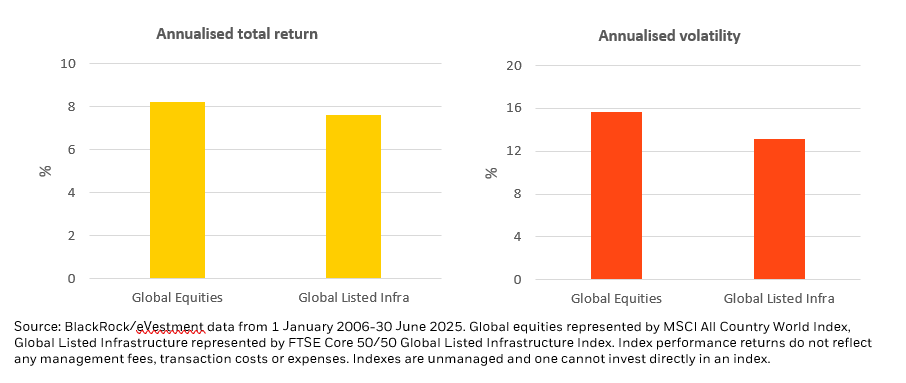
Over the last two years as global equities have faced a rollercoaster ride driven by macro volatility, rising geopolitical risk and AI valuation concerns, infrastructure has shown a low correlation of just 0.03 to equity market performance.5
Minimum volatility strategies are another option for investors looking to reduce the impact of drawdowns, having significantly outperformed broad equity markets during key downturn periods such as the GFC and COVID onset.6
As volatility set in in the first quarter of 2026, the iShares MSCI World ex Australia Minimum Volatility ETF (WVOL) returned 0.29% in the three months to March, versus the MSCI World ex Australia at -6.12% - demonstrating the advantage of leaning into this type of strategy at times of market nerves.7 Over a longer term 5 year time horizon, WVOL has returned roughly 10% per year.8
While tilting towards lower volatility stocks, the index tracked by WVOL is restricted in how far it can stray from the MSCI World, making it suitable as a long-term core holding alongside or replacing a broad index.
The MSCI World Minimum Volatility Index and MSCI World Index have both generated approximately 8% annualised returns since the inception of the MSCI World Minimum Volatility Index in 1988.9
Brace for potential stagflation
Key strategies: Cash-plus, inflation-linked bonds
Rising oil prices add a significant layer of complexity to Australia’s domestic inflation challenge that pre-dates the Middle East conflict. The risk of a flow-on impact to services inflation and wages is real, supporting the case for an aggressive hiking cycle from the RBA as some economists have suggested.
But given the drag that oil prices will place on economic growth, we think the central bank is likely to proceed cautiously on further rate rises – as suggested by minutes from the RBA’s latest meeting, which showed divided views on the need for consecutive hikes.
For those wary of carrying significant interest rate risk given the uncertainty of the central bank’s next move, cash-plus ETFs like the iShares Enhanced Cash ETF (ISEC) continue to deliver income in line with the cash rate of around 4% p.a., without meaningful sensitivity to volatility in the bond market.10
In the case of a low-growth, high-inflation environment where the RBA is hamstrung in its ability to hike, inflation-linked bonds such as the iShares Government Inflation ETF (ILB) may offer protection by adjusting investors’ principal amount with CPI.
ILB has seen more than $130 million in flows from local investors since the start of the Middle East conflict , indicating concerns of a potential ‘stagflationary’ environment ahead.
Take advantage of dispersion
Key strategy: Gold
Despite the recent reset in prices, we still like gold as a tactical play with long-term price drivers that are likely to persist beyond the current crisis – and as a portfolio diversifier, with a correlation of just 0.38 to the MSCI World Index so far this year.8
The precious metal should continue to benefit from the erosion of other traditional safe haven assets as developed market government debt rises. Amid concerns over the US fiscal deterioration, gold overtook US Treasury bonds last year as the largest share of global central bank reserve assets for the first time since 1996.9
It’s also a much easier asset class for investors to access than it has been historically, with gold ETFs like the iShares Physical Gold ETF (GLDN) allowing daily trading for a low cost.
With more than 450 ETFs now available on the ASX10, the range of strategies available can help investors best position their portfolios for a low-growth, high-inflation environment. With risks multiplying and traditional hedges becoming less reliable, drawing on a wider set of portfolio diversifiers to limit broad market exposure could prove useful.
- Source: BlackRock data as of 21 April 2026
- Source: Bloomberg as of 4 May 2026
- Source: BlackRock data as of 21 April 2026, based on IShares ETF flow data from 1 March 2026-21 April 2026. Past flows are not a guide to current or future flows and should not be the sole factor of consideration when making an investment decision
- Source: Morningstar data as of 28 February 2026. Based on MSCI World Index vs FTSE Core Global Infrastructure 50/50 Index correlations from January 2024-January 2026
- Source: MSCI data as of 14 May 2024
- Source: MSCI data as of 31 January 2026. Based on average annual returns of MSCI World Minimum Volatility Index vs MSCI World Index since MSCI World Minimum Volatility Index inception (31 May 1988). Index performance returns do not reflect any management fees, transaction costs or expenses. Indexes are unmanaged and one cannot invest directly in an index.
- Source: BlackRock data as of 21 April 2026, based on IShares ETF flow data from 1 March 2026-21 April 2026. Past flows are not a guide to current or future flows and should not be the sole factor of consideration when making an investment decision
- Source: BlackRock data as of 21 April 2026
- Source: BlackRock data as of 19 January 2026.
- Source: Australian Financial Review, 22 April 2026
Product Details:
iShares Government Inflation ETF
This product is likely to be appropriate for a consumer:
• who is seeking capital preservation and/or income distribution
• using the product for a core component of their portfolio or less
• with a minimum investment timeframe of 3 years
• with a medium risk/return profile
iShares Government Inflation ETF | ILB
iShares Core S&P/ASX 200 ETF
This product is likely to be appropriate for a consumer:
• who is seeking capital growth and/or income distribution
• using the product for a core component of their portfolio or less
• with a minimum investment timeframe of 5 years
• with a medium to high risk/return profile
iShares Core S&P/ASX 200 ETF | IOZ
iShares Treasury ETF
This product is likely to be appropriate for a consumer:
• who is seeking capital preservation and/or income distribution
• using the product for a core component of their portfolio or less
• with a minimum investment timeframe of 3 years, and
• with a medium risk/return profile
iShares S&P 500 ETF
This product is likely to be appropriate for a consumer:
• who is seeking capital growth
• using the product for a core component of their portfolio or less
• with a minimum investment timeframe of 5 years, and
• with a medium to high risk/return profile
iShares Global High Yield Bond (AUD Hedged) ETF
This product is likely to be appropriate for a consumer:
• who is seeking capital preservation and/or income distribution
• using the product for a major allocation of their portfolio or less
• with a minimum investment timeframe of 5 years, and
• with a medium risk/return profile
iShares Global High Yield Bond (AUD Hedged) ETF | IHHY
iShares Core FTSE Global Infrastructure (AUD Hedged) ETF
This product is likely to be appropriate for a consumer:
• who is seeking capital growth and/or income distribution
• using the product for a core component of their portfolio or less
• with a minimum investment timeframe of 5 years, and
• with a medium to high risk/return profile
iShares Core FTSE Global Infrastructure (AUD Hedged) ETF | GLIN
iShares MSCI World ex Australia Minimum Volatility ETF
This product is likely to be appropriate for a consumer:
• who is seeking capital growth
• using the product for a major allocation of their portfolio or less
• with a minimum investment timeframe of 5 years, and
• with a medium risk/return profile
iShares MSCI World ex Australia Minimum Volatility ETF | WVOL
iShares Enhanced Cash ETF
This product is likely to be appropriate for a consumer:
• who is seeking capital preservation and/or income distribution
• using the product for a whole portfolio solution or less
• with no minimum investment timeframe, and
• with a very low risk/return profile
iShares Enhanced Cash ETF | ISEC
iShares Physical Gold ETF
This product is likely to be appropriate for a consumer:
• who is seeking capital preservation and/or capital growth
• using the product for a minor allocation of their portfolio or less
• with a minimum investment timeframe of 5 years, and
• with a high to very high risk/return profile
iShares Physical Gold ETF | GLDN
Disclaimer:
Opinions are subject to change, and they are not a guarantee of future results. This information should not be relied upon as research, investment advice or a recommendation. Diversification and asset allocation may not fully protect you from market risk.
This information has been provided by BlackRock Investment Management (Australia) Limited (BIMAL) for WealthHub Securities Limited (WSL) (ABN 83 089 718 249)(AFSL No. 230704). WSL is a Market Participant under the ASIC Market Integrity Rules and a wholly owned subsidiary of National Australia Bank Limited (ABN 12 004 044 937)(AFSL No. 230686) (NAB). NAB doesn’t guarantee its subsidiaries’ obligations or performance, or the products or services its subsidiaries offer. This material is intended to provide general advice only. It has been prepared without having regard to or taking into account any particular investor’s objectives, financial situation and/or needs. All investors should therefore consider the appropriateness of the advice, in light of their own objectives, financial situation and/or needs, before acting on the advice. Past performance is not a reliable indicator of future performance. Any comments, suggestions or views presented do not reflect the views of WSL and/or NAB. Subject to any terms implied by law and which cannot be excluded, neither WSL nor NAB shall be liable for any errors, omissions, defects or misrepresentations in the information or general advice including any third party sourced data (including by reasons of negligence, negligent misstatement or otherwise) or for any loss or damage (whether direct or indirect) suffered by persons who use or rely on the general advice or information. If any law prohibits the exclusion of such liability, WSL and NAB limit its liability to the re-supply of the information, provided that such limitation is permitted by law and is fair and reasonable. For more information, please click here.
Important Information: This material has been created with the co-operation of BlackRock Investment Management (Australia) Limited (BIMAL) ABN 13 006 165 975, AFSL 230 523 on 5 May 2026. Comments made by BIMAL employees here represent BIMAL’s views only. This material provides general advice only and does not take into account your individual objectives, financial situation, needs or circumstances. Where BIMAL funds are referenced - Read the Product Disclosure Statement (PDS) and Target Market Determination (TMD) at blackrock.com/au to see if the products referenced are appropriate for you. Before making any investment decision, you should obtain financial advice tailored to you having regard to your individual objectives, financial situation, needs and circumstances. Refer to BIMAL’s Financial Services Guide at blackrock.com/au for more information. This material is not a financial product recommendation or an offer or solicitation with respect to the purchase or sale of any financial product in any jurisdiction. All currency in AUD unless otherwise stated.