


Insurance brokers: not as easy to displace as the AI headlines suggest
Steven Glass | Pella Funds Management
Figure 1 – 2025 was all about the AI winners… whereas 2026 has so far been all about the perceived victims
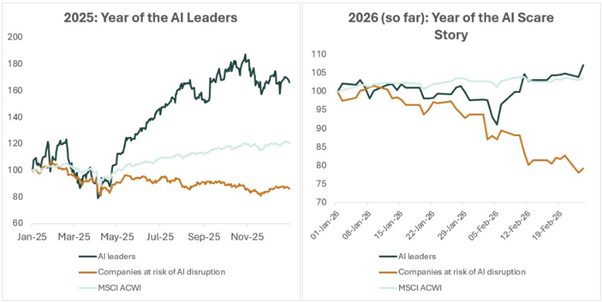
Source: Goldman Sachs and MSCI index performance; Pella Funds Management calculations based on Bloomberg-sourced data
As the chart on the left in Figure 1 shows, Goldman Sachs’ GSTMTAIL Index (a basket of “AI Leaders”) significantly outperformed during 2025. In contrast, the chart on the right shows the underperformance so far in 2026 of the GSTMTAIR Index, which tracks companies perceived to be at risk of AI disruption.
The “at risk” basket includes companies across a range of sectors
For example:
- Software – the first group to be marked down as a potential victim of AI, in what some are referring to (only semi-jokingly) as the “SaaSpocalypse”.
- Information Services – driven by fears that AI could replicate their data and analytics offerings more cheaply.
- Insurance Brokers – based on the perception that AI agents could disintermediate them.
- Wealth Managers – following the release of an AI-powered platform designed to offer automated tax planning and workflow management for advisers.
These sell-offs have generally been driven by high-level predictions about future disruption, often triggered by relatively minor developments in the AI space, rather than any identifiable deterioration in the companies’ competitive position or financial performance.
At the same time, the companies’ own AI-based revenue and productivity initiatives, which had previously been receiving some credit from the market, are now largely being ignored.
In some cases, it is entirely plausible that AI developments could pose a meaningful threat to existing business models. However, in other cases, the disruption narratives appear overly simplistic and/or exaggerated. Either way, the market’s response to each new scare story has been to shoot first and ask questions later.
One area where we believe the risk has been significantly overstated is insurance broking.
This is also the only sector among those outlined above where Pella has had meaningful exposure. Therefore, we thought it would be useful to explain why the real-world risk to insurance brokers is much lower than some of the headline theories suggest.
To be clear, we understand why the market was spooked. Insurance broking is one of those rarely discussed, niche industries where the workings are a lot more complex than they appear from a distance. Therefore, the disintermediation narrative can sound quite plausible.
The simplified version of the scare story goes something like this:
- Insurance brokers are assumed to provide only one real service: finding the cheapest insurance policy.
- The commission that brokers receive for this service is assumed to be (a) a very large portion of the total cost to the client and (b) a direct add-on to what the price would otherwise have been.
- On that basis, it would seem reasonable to conclude that an AI “shopping agent” capable of seeking out the cheapest policy could save the client a lot of money and ultimately remove the need for brokers altogether.
However, none of the key assumptions leading up to that conclusion are entirely correct.
Misconception #1: Brokers provide one simple service – finding the cheapest insurance cover.
Reality
A broker’s role begins well before any policy is purchased. Brokers advise clients on the appropriate combination of policies, how much risk to retain versus insure, and how to structure their coverage.
They then source the best value insurance, which is not necessarily the cheapest. Policy terms and conditions vary significantly between insurers, as does insurer quality and claims reliability.
Importantly, brokers also provide ongoing services after the policy is placed, including claims support, policy adjustments, and risk management advice.
Implication
AI agents may eventually be able to provide a purchasing service for clients with very simple, standardised insurance needs, such as personal auto/home policies or packaged cover for micro-SMEs.
However, clients using such a service would forgo:
- Tailored advice on balancing price versus the amount of cover purchased and the quality of that coverage.
- Expert assistance navigating policy wording and exclusions.
- The post-purchase services that a broker provides (like managing the claims process).
For more complex insurance needs, the broker’s services will remain very difficult to replicate through complete automation.
Misconception #2: By using an AI agent, clients can simply skip paying the broker’s commission, enabling them to save a lot of money on their insurance.
Reality
Even if an insurer offered exactly the same product through an AI agent, the price wouldn’t simply come down by the amount of the broker’s bundled commission.
To begin with, the AI platform would still need to capture some economic value for facilitating the transaction.
The insurer would then need to increase its base pricing to cover the cost of the various administrative and client servicing functions that had previously been outsourced to the broker.
The insurer would also need to raise it base pricing to account for the likelihood of higher average claim costs under the AI arrangement (because brokers effectively act as a filter, helping insurers avoid lower-quality clients, non-disclosure issues and poorly structured policies).
Implication
Even if an AI platform was willing to settle for a very small fee, the net price reduction for the client would likely be a lot smaller than the size of the broker commission.
This is particularly relevant given that the bundled commission rate for the large global brokers typically averages in the low teens, rather than the commonly perceived 20%+.
Importantly, any remaining price reduction could then prove to be a false economy if the selected cover contains gaps in policy terms or inadequate coverage levels.
This risk becomes especially significant in the event of a claim. A 2025 study found that brokers successfully contested 18% more denied claims than clients dealing directly with insurers’ automated claims systems.
In practice, a single avoided claim denial can far outweigh the cost of the broker’s commission.
Misconception #3: Insurers would prefer to bypass brokers in order to save on commissions.
Reality
The entire case for AI purchasing agents is built on the assumption that clients would benefit from lower prices. This means insurers would be unlikely to retain any meaningful pricing benefit for themselves.
Meanwhile, insurers like dealing with brokers because they:
- Reduce the insurer’s administrative burden.
- Help the insurer avoid lower-quality clients, non-disclosure issues and poorly structured policies.
- Facilitate complex placements.
The major insurers would also be very reluctant to sponsor a new distribution channel that would end up prioritising raw price over quality factors (such as the insurer’s terms of cover, reputation and balance sheet strength).
Implication
For the smallest clients (personal and micro-SMEs) and the simplest forms of insurance, AI agents may be able to operate without the co-operation of the major insurers.
However, as we move into the realm of larger commercial clients with more complex insurance needs (i.e. the core revenue base of the major brokers), AI agents would need the co-operation of the insurers in order to get bespoke price indications and policy structures. We believe the major insurers would be very reluctant to do this.
Even if the insurers were willing to play ball, their cost of servicing an AI purchasing system would be prohibitive unless they could communicate on a fully automated “bot-to-bot” basis. Once we go beyond the smallest clients and the simplest policies, this would be extremely difficult to implement in practice, due to the need for bespoke policy design and pricing.
Additional structural barriers to disintermediation
Beyond the misconceptions outlined above, the following factors should strengthen the brokers’ position.
Proprietary data advantages
The global brokers each possess massive banks of proprietary data (i.e. data that would not be available to an AI agent), covering things like industry-specific risk characteristics, insurance pricing and claims experience.
This data allows them to provide valuable benchmarking and risk insights to clients. It is also of great value to the insurers, who lack the cross-market data about other insurers’ clients that only the brokers can provide.
Complex program structuring
Large brokers are able to assemble holistic insurance solutions for their clients, often combining multiple policies across several insurers and sometimes requiring access to specialist underwriters.
This type of structuring would be very difficult to replicate through automated purchasing systems.
Regulatory and legal constraints
Insurance advice is also subject to regulatory frameworks around accountability, liability and fiduciary responsibility.
For example, in some US jurisdictions, regulators have ruled that while AI can gather data, compare quotes and even facilitate a transaction, the “duty to advise” cannot be delegated entirely to an automated system.
In these cases, if AI provides a recommendation, a human adviser must still sign off to confirm it meets regulatory suitability standards.
Conclusion: The real disruption risk sits at the very small end of the market
Our analysis indicates that smaller clients with simple insurance needs (such as individuals seeking auto/home policies or micro-SMEs buying standardised business packages) may well be disintermediated by AI platforms over time. Whether this ultimately ends up being in their best interests is another question altogether.
That segment of the market can be important for small “main street” brokers. However, it only represents a minor portion of the global brokers’ revenue base. Generic personal lines would account for perhaps 1–2% of their total revenue. Even after including simple packaged products for small businesses, their exposure is unlikely to average much more than mid-single digits.
As we move up into larger and more specialised SMEs, the barriers rise and the risk of meaningful disintermediation drops off quite significantly. Once we enter the realm of medium-sized businesses, the risk becomes extremely low. And, by the time we get to large corporate clients, enterprises and reinsurance placement, it becomes largely academic.
This leads us to the conclusion reflected in the title of this article: Insurance Brokers – not as easy to displace as the AI headlines suggest.
Meanwhile, the major brokers have been investing heavily in their own internal AI capabilities.
These tools should enable them to:
- Improve productivity.
- Enhance client service and retention.
- Deepen the value of their proprietary data assets.
In effect, the incumbents are already co-opting AI to strengthen their competitive advantages and expand margins.
As their smaller competitors struggle to keep up (due to a combination of budgetary and data constraints), the large brokers’ pipeline of bolt-on acquisition opportunities should also keep expanding.
Therefore, while AI-related news flow may continue to create periods of share price volatility, we remain very comfortable with our portfolio exposure to the insurance broker space.
Learn how the industry leaders are navigating today's market every morning at 6am. Access Livewire Markets Today.
All prices and analysis at 12 March 2026. This document was originally published in Livewire Markets on 12 March 2026. This information has been prepared by Pella Funds Management (ABN: 36 650 028 103)(AFSL No: 541327). The content is distributed by WealthHub Securities Limited (WSL) (ABN 83 089 718 249)(AFSL No. 230704). WSL is a Market Participant under the ASIC Market Integrity Rules and a wholly owned subsidiary of National Australia Bank Limited (ABN 12 004 044 937)(AFSL No. 230686) (NAB). NAB doesn’t guarantee its subsidiaries’ obligations or performance, or the products or services its subsidiaries offer. This material is intended to provide general advice only. It has been prepared without having regard to or taking into account any particular investor’s objectives, financial situation and/or needs. All investors should therefore consider the appropriateness of the advice, in light of their own objectives, financial situation and/or needs, before acting on the advice. Past performance is not a reliable indicator of future performance. Any comments, suggestions or views presented do not reflect the views of WSL and/or NAB. Subject to any terms implied by law and which cannot be excluded, neither WSL nor NAB shall be liable for any errors, omissions, defects or misrepresentations in the information or general advice including any third party sourced data (including by reasons of negligence, negligent misstatement or otherwise) or for any loss or damage (whether direct or indirect) suffered by persons who use or rely on the general advice or information. If any law prohibits the exclusion of such liability, WSL and NAB limit its liability to the re-supply of the information, provided that such limitation is permitted by law and is fair and reasonable. For more information, please click here.