


It’s beginning to look a lot like Christmas……
Henry Jennings | Marcus Today
As we approach the end of 2025, it’s interesting to look back and see what we’ve learned from the year — and whether we can extrapolate that into 2026. It’s fair to say it has been a particularly interesting year, with the inauguration of Donald Trump in January kicking off what has, at times, been a turbulent backdrop.
The new US administration has stuck to its plan hatched over the past four years, known as ‘Project 2025’. It has also adopted what Steve Bannon calls “flooding the zone”, and at times, the pace of announcements and the changes we have seen in the US landscape have come thick and fast. Only the other night, Mr Trump, while sitting quietly watching his favourite Fox News channel, tweeted 160 times during one night. There’s certainly nobody who could question his energy. He has been a whirlwind this year, with his eyes firmly fixed on the prize of a Nobel Peace Prize after solving the Gordian knot that was the Israel–Gaza conflict. Maybe he could finish the year with a Ukraine–Russia peace deal, or at the very least, a ceasefire.
For markets, it has at times been a rollercoaster ride. We had the now-infamous board that Trump held up in the Oval Office detailing the new tariff regime, which was quickly wound back as Wall Street spat the dummy. From then on, it has been onwards and upwards, with only the occasional blip along the way — mainly to do with the great AI bubble, the challenge from China with DeepSeek, and whether the NVIDIA miracle will continue with its dominance of the latest chips.
We even saw ChatGPT celebrate its third birthday the other day, and I have to say, the pace of change that artificial intelligence has brought to the world has been significantly underwhelming in some respects. Not so underwhelming, however, has been the massive amount of investment that has found its way into every corner of the AI trade, as an arms race between the ‘hyperscalers’ continues, with “who can spend the most money” very much the name of the game. Question marks have, of course, emerged as to whether the return on investment is enough to justify the massive amount of cash that big tech companies are splashing on the latest chips. Michael Burry of The Big Short fame has questioned the depreciation cycle of these chips, and there is no doubt that their lifespan is short, running hot 24/7. It is not just about replacing old technology with the latest and greatest — it is also about replacing the latest and greatest with an even newer version because they simply wear out.
As we head into Christmas, strategists and investors have questioned whether we will get the traditional Santa Claus rally. Like all traditions, however, they are not always guaranteed. If we turn away from the question of the AI bubble and look at the US economy, it is still going pretty well, to say the least — even allowing for the lack of official data due to the government shutdown. There is little doubt that at the Federal Reserve, the path of least resistance is toward lower interest rates. With Jerome Powell set to leave his position in May and Kevin Hassett looking likely to take over as head of the Federal Reserve — a job guaranteed for 14 years, by the way — he is very much in the Trump camp of pushing rates down. He has talked about a target of 3%.
In an environment of lower interest rates, with US tax cuts coming through next year to help the consumer (not that the American consumer needs much help), corporate profits holding up, and with 2026 being a US midterm election year, we have already seen how Trump has cut tariffs on produce from far-away countries that supply bananas and coffee, which had been adding to the cost of living. He is a president who wants to be popular. He is a president who needs to be popular. And he is a president who, at least in his own mind, is “for the people, by the people, and with the people”. Against that backdrop, it is difficult to see Trump creating an environment that would take down the stock market for any sustained period of time.
Although many believe we are in an AI bubble, there are just as many who believe this is not a bubble at all — that we are merely getting started. The productivity gains from the artificial intelligence revolution, which is only three years old, are expected to be substantial and will enable US corporations and others around the world to do more with a lot less. “A lot less”, of course, being the actual workers — the most costly part of the equation.
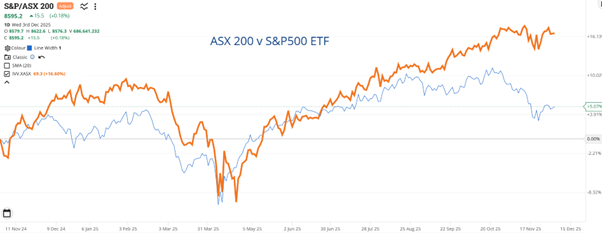
As we head into 2026, there is a certain amount of optimism to be gleaned from current market conditions. Here in Australia, the ASX has pulled back significantly as we have gone risk-off.
Source: Marcus Today
This flies in the face of what has happened in the US, where, after a brief pullback, markets have resumed their seemingly inevitable rise and pushed ever higher. The Australian economy, however, is not built on AI. It is not built on technology to the same extent as the US, nor is it built on the consumer. What we do have is banks and miners.
Much has been said about the banks being ex-growth, and they are ex-growth. It is hard to find growth in a population of only 27m where the Big Four dominate and competition is rife. It is like four bald men fighting over a comb. So, if we assume the banks do very little, it will be up to the industrials and the miners to lift. And we are already seeing that. Many metals have had a stunning 2025 — gold, silver, platinum, palladium and copper among them. These extraordinary moves are likely to continue next year, and we should see higher valuations for the mining sector as analysts are forced to upgrade their long-term assumptions after considering current commodity prices.
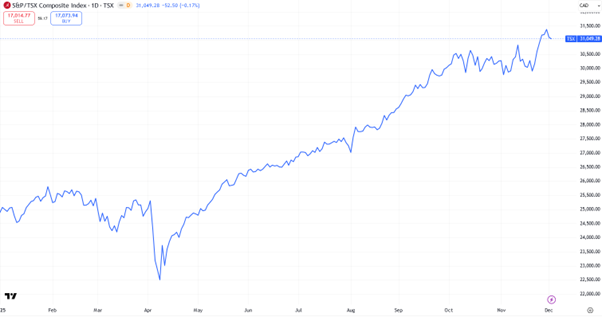
Our economy is similar to Canada’s.
Source: Marcus Today
The TSX is trading at record highs — not because their miners are doing any better than ours, but because their banks have not stumbled to the same extent as ours, which are down around 11% from recent highs. How is it that Canada, with a relatively static population of 40m, under siege from the US on tariffs, and with an economy not doing as well as ours,6.9% unemployment, is at record highs? There is an easy answer: the Bank of Canada has been cutting rates. Their interest rate is now 2.25%, whereas the RBA is at 3.6%.
The Canadians have conquered inflation, only 2.2%, whereas here it is still elevated at 3.8%, partly as a result of energy policy and partly due to government tax and excise price rises. Unfortunately, Michele Bullock and the board at the RBA are in no mood to cut interest rates. In fact, given the last inflation read well above economist forecasts, there are some now factoring in that the next move in interest rates will be higher. That would be ‘very courageous, Governor’.
In conclusion, there is no reason to suggest that the themes of 2025 will not carry forward into 2026. What we could see is a reinvigoration of the US economy due to lower interest rates and tax cuts, stirring the consumer. We could also see the impact of tariffs gradually seep into the US economy, but with midterms on the horizon at the end of next year, maybe we will see Taco Man at his best and some backing down on tariffs.
For the ASX, it feels as if we have been too sensitive — too quick to jump on the bear trade, too quick to sell down the banking sector, and too reluctant to fully embrace the resource sector, which is due for a significant upgrade. While we remain fixated on the price of iron ore, gold is trading at 6,400 Australian dollars, and many other commodities are trading at impressive highs. It is only a matter of time before we see upgrades from analysts or increased M&A activity from predators looking to increase their resource exposure.
We have had a taste this year of how dominant China is in critical metals and rare earths. That is not about to change. It will require investment, and it will require commitment to break that dominance, and so I firmly believe that 2026 will continue to be a year where resources are the place to be. At the end of the day, you buy the US for technology and AI, and you buy Australia for resources. And as we know, you can’t have the AI revolution without the resources and the energy to power that revolution.
2026 will not be a year for lazy money. It will be volatile, noisy and full of competing narratives. We will see a broadening out of the AI story. We will continue to see opportunities outside of the US. The easy gains of 2025 are likely behind us. From here, returns will be earned the hard way — through discipline, conviction, diversification and sharp risk management. The bull market may still be alive, but it is maturing. The path of least resistance still appears higher, just not in a straight line. Stock picking will matter again. Timing will matter again. And for investors willing to stay active, stay curious and stay brave, opportunity will not be in short supply.
A free trial of the Marcus Today newsletter for nabtrade clients is available here.
All prices and analysis at 3 December 2025. This information has been prepared by Marcus Today Pty Limited. Marcus Today Pty Ltd ABN 57 110 971 689 is a Corporate Authorised Representative (no. 310093) of AdviceNet Pty Ltd ABN 35 122 720 512 (AFSL 308200). The content is distributed by WealthHub Securities Limited (WSL) (ABN 83 089 718 249)(AFSL No. 230704). WSL is a Market Participant under the ASIC Market Integrity Rules and a wholly owned subsidiary of National Australia Bank Limited (ABN 12 004 044 937)(AFSL No. 230686) (NAB). NAB doesn’t guarantee its subsidiaries’ obligations or performance, or the products or services its subsidiaries offer. This material is intended to provide general advice only. It has been prepared without having regard to or taking into account any particular investor’s objectives, financial situation and/or needs. All investors should therefore consider the appropriateness of the advice, in light of their own objectives, financial situation and/or needs, before acting on the advice. Past performance is not a reliable indicator of future performance. Any comments, suggestions or views presented do not reflect the views of WSL and/or NAB. Subject to any terms implied by law and which cannot be excluded, neither WSL nor NAB shall be liable for any errors, omissions, defects or misrepresentations in the information or general advice including any third party sourced data (including by reasons of negligence, negligent misstatement or otherwise) or for any loss or damage (whether direct or indirect) suffered by persons who use or rely on the general advice or information. If any law prohibits the exclusion of such liability, WSL and NAB limit its liability to the re-supply of the information, provided that such limitation is permitted by law and is fair and reasonable. For more information, please click here.