


What has reporting season taught us?
Henry Jennings | Marcus Today
Firstly, volatility remains both a risk and an opportunity. This August we have continued to see some outsized moves on the day of results, and sometimes that move is reversed in the days afterwards. That applies both ways.
We have learned that shorting stocks can be dangerous, especially when results turn out better than expected. There is nothing quite like being short a stock when the company delivers a result that everyone else suddenly decides is fantastic!
We have also learned that maybe we were all a little too pessimistic about reporting season overall. We planned for the worst and, in many cases, got something considerably better than anticipated.
Where we have seen cracks is in the banks. I am not sure why anyone was particularly surprised, frankly. Since the Budget in May, the media has been full of doom and gloom stories about housing.
The Big Four banks, the Four Pillars, are essentially building societies on steroids. Massive exposure to housing and mortgages. That is fine when they are all playing nicely in the sandpit, and the rules of the game are known and conducive to everyone playing nicely.
But when the rules change, and it starts to get a little more ‘Lord of the Flies’, competition can hurt.
The Big Four still make enormous profits, so let's not feel too sorry for them. They will still make $30bn-plus in cash profits. Not bad when you consider there are 27 million people in Australia generating $30bn of profits for four banks.
There are no great international growth plans; I am not counting New Zealand, and there are relatively few growth levers they can pull. A nice, cosy quadropoly.
But competition for the mortgage dollar is taking its toll.
So far, however, there is no sign of widespread distress among borrowers, despite rates rising.
There is no doubt the economy is slowing, and consumers are under pressure. But it is not across the board.
Not all retailers are equal. Some have managed to defy the gloom and press ahead. UNI has done well. KGN has not! But things are tough out there. Cost-of-living pressures, high interest rates and weaker discretionary spending are increasingly evident. Even where sales are growing, margins are often under pressure.
And margins are becoming an issue.
We saw that with JBH in its numbers, as the price of technology rises with chips and components becoming more expensive. We saw it too in DRO, where margins shrank because of a change in product mix.
Both suffered as a result.
Then there is the big driver of the gains on the ASX this month: resources.
BHP is pushing to record highs. The resource story is real. Gold and copper prices are running hard. Forecast earnings growth was expected to come from Resources, and they have delivered.
Given we get quarterly numbers from the miners and commodity prices every day, this should not have come as a great shock to many. But apparently it did!
Healthcare is another sector that has been rewarded after what look like overly pessimistic expectations.
Can you believe it was possible to buy CSL at around $95? Easy with hindsight, of course, but so much pessimism had been built into the stock. The same applied to COH and ANN, with better-than-expected results helping to turn sentiment around.
Maybe part of the attraction is simply mirroring the rises we have seen in the US healthcare space. Maybe it is defensive. Maybe it is an alternative to AI and tech.
The same could apply to resources too. Perhaps investors are simply looking for something that isn't another AI trade.
Dividends are also strong, and many companies have announced new buybacks.
Buybacks give a company more flexibility than a dividend because they can control the pace or even suspend the buyback if circumstances dictate. Dividends offer no such flexibility. Once they are gone and paid, that is it.
Guidance, as always, is key. You can sometimes get away with disappointing numbers if you provide good guidance. Although the 'second half' story needs to be credible. It needs to stand up to inspection.
The plan cannot simply be one that Baldrick has hatched in the boardroom five minutes before the results presentation.
Around 44% of reporting companies have beaten expectations, while 26% have missed, and forecasts have been trimmed by around 2%.
So, what does it all mean?
The Australian economy isn't falling off a cliff, but it is becoming increasingly two-speed.
Resources, healthcare, infrastructure, AI/data centres and businesses with strong balance sheets are generally doing well.
The consumer, property, highly leveraged businesses and companies exposed to discretionary spending are where the cracks are appearing.
The reporting season has been better than feared, but not necessarily as good as the headline numbers suggest. The winners are getting rewarded, the mediocre are being found out, and the consumer is increasingly becoming the problem.
And perhaps the most important lesson of all is that the market is increasingly looking through the FY26 numbers and pricing FY27.
A record profit is yesterday's news. What matters now is cash flow, margins, dividends and guidance.
Because the market, as always, is less interested in what you did yesterday and far more interested in what you are going to do tomorrow.
It is also worth pointing out that after the sunshine comes rain. The market has pushed to near record highs during this season; September is when the market goes ex-dividend. That will weigh on the ASX200. It is also the month when the US Masters of the Universe come back from the Hamptons or Catalina and get down to work again. Things can get a little more negative. Returning to work can have that effect. September can be a disappointing month, especially after the fatigue and adrenaline of reporting season. Expect some consolidation and perhaps index weakness in September.
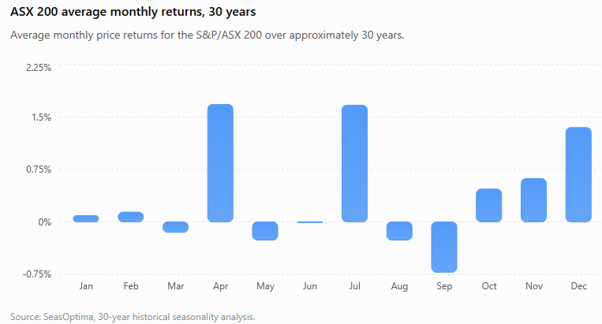
Over the last 30 years, September has been the worst month for the ASX 200, with an average return of around -0.7%. It has been positive in fewer than half of those years.
Is September the buying opportunity as the run into Christmas kicks off? We shall see.
A free trial of the Marcus Today newsletter for nabtrade clients is available here.
All prices and analysis at 26 August 2026. This information has been prepared by Marcus Today Pty Limited. Marcus Today Pty Ltd ABN 57 110 971 689 is a Corporate Authorised Representative (no. 310093) of AdviceNet Pty Ltd ABN 35 122 720 512 (AFSL 308200). The content is distributed by WealthHub Securities Limited (WSL) (ABN 83 089 718 249)(AFSL No. 230704). WSL is a Market Participant under the ASIC Market Integrity Rules and a wholly owned subsidiary of National Australia Bank Limited (ABN 12 004 044 937)(AFSL No. 230686) (NAB). NAB doesn’t guarantee its subsidiaries’ obligations or performance, or the products or services its subsidiaries offer. This material is intended to provide general advice only. It has been prepared without having regard to or taking into account any particular investor’s objectives, financial situation and/or needs. All investors should therefore consider the appropriateness of the advice, in light of their own objectives, financial situation and/or needs, before acting on the advice. Past performance is not a reliable indicator of future performance. Any comments, suggestions or views presented do not reflect the views of WSL and/or NAB. Subject to any terms implied by law and which cannot be excluded, neither WSL nor NAB shall be liable for any errors, omissions, defects or misrepresentations in the information or general advice including any third party sourced data (including by reasons of negligence, negligent misstatement or otherwise) or for any loss or damage (whether direct or indirect) suffered by persons who use or rely on the general advice or information. If any law prohibits the exclusion of such liability, WSL and NAB limit its liability to the re-supply of the information, provided that such limitation is permitted by law and is fair and reasonable. For more information, please click here.