


Cheapest ASX member of our Best Idea’s list
Angus Hewitt, CFA | Morningstar
Negative sentiment amid short-term headwinds, management tumult, and structural changes facing the automotive industry has left the fundamental strength and resilience of Bapcor’s (ASX: BAP) automotive-parts business underappreciated.
A slowdown in discretionary spending weighs on retail, and the new management team will need to deliver on a turnaround that’s proving painful in the short term. The proliferation of electric vehicles is also a long-term obstacle for the trade business. However, we think management is focusing on the right things: simplifying the business, removing costs, and strengthening the competitive advantages in trade that underpin Bapcor’s narrow economic moat.
We believe the auto-parts industry is fundamentally resilient and Bapcor will successfully adapt to the gradual technological transition. The shares are trading at a 54% discount to our fair value of $4.70.
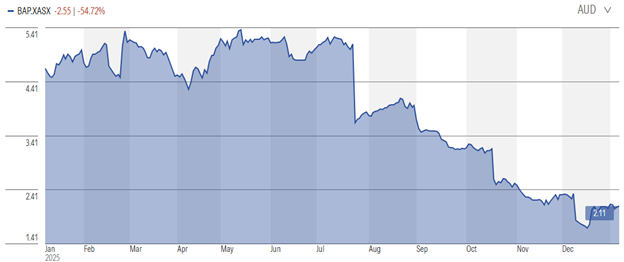
Source: Morningstar
Business strategy and outlook
We expect Bapcor’s strong earnings per share growth to return as the competitively advantaged trade business capitalizes on favorable industry dynamics. We forecast Bapcor to resume share gains in the fragmented trade market as it rolls out stores. We forecast a double-digit EPS compound annual growth rate over the next five years as the business recovers from trough earnings in fiscal 2026, improving same-store sales growth of around 2%-3% per year and growing private-label penetration.
The automotive spare-parts industry is resilient. Automotive spare parts, required for routine maintenance and repair of vehicles, are less affected by changes in discretionary income and consumer confidence, and demand is broadly driven by the increasing pool of vehicles. We expect the number of registered vehicles to continue growing at a low-single-digit CAGR over the next decade, roughly in line with population growth. We estimate there are currently around 20 million passenger vehicles in Australia with an average age of about 11 years. We also argue an element of countercyclicality for auto parts. While maintenance can be delayed to some extent, it cannot be ignored completely. Conversely, we expect new-vehicle sales to slow in an economic downturn as consumers choose to maintain their existing car rather than upgrade to a newer vehicle.
We expect Bapcor’s trade business, which contributes the majority of earnings, to continue to capture market share. Bapcor’s trade store network underpins the firm’s narrow economic moat and affords the firm competitive advantages over smaller competitors. This network allows Bapcor to stock over 500,000 stock-keeping units, many of these slow-moving, for over 20,000 different vehicles—an offering that we believe smaller players will be unable to replicate. Bapcor is investing in this competitive position, targeting an increase in stores in Australia and New Zealand. We expect its new stores will come at the expense of competitively disadvantaged smaller players, which we anticipate will make up more than 40% of the market, due to Bapcor’s ability to provide parts to commercial customers more quickly, reliably, and at a lower cost.
Bulls say
- The trade segment is highly fragmented, affording significant headroom for Bapcor to capture share at the expense of smaller players.
- As vehicles become increasingly more complex, DIY customers could gravitate toward outsourcing to mechanic workshops—customers of Bapcor’s higher-margin trade business.
- A strong balance sheet affords Bapcor the ability to execute its store network expansion and potentially pursue further accretive acquisitions.
Bears say
- Electric vehicles present a longer-term threat to Bapcor’s business, as they have fewer moving parts.
- Existing trade customer relationships could be difficult to replace, given their relative price inelasticity, damping Bapcor’s store network expansion plans.
- A consumer shift to digital sellers (such as Amazon) or more competitive activity from the two larger players in the DIY segment could increase pricing pressure on Bapcor’s retail business.
Access this research and more at Morningstar. For a free four-week trial, click here.
All prices and analysis at 6 January 2026. This information has been prepared by Morningstar Australasia Pty Limited (“Morningstar”) ABN: 95 090 665 544 AFSL: 240 892.). The content is distributed by WealthHub Securities Limited (WSL) (ABN 83 089 718 249)(AFSL No. 230704). WSL is a Market Participant under the ASIC Market Integrity Rules and a wholly owned subsidiary of National Australia Bank Limited (ABN 12 004 044 937)(AFSL No. 230686) (NAB). NAB doesn’t guarantee its subsidiaries’ obligations or performance, or the products or services its subsidiaries offer. This material is intended to provide general advice only. It has been prepared without having regard to or taking into account any particular investor’s objectives, financial situation and/or needs. All investors should therefore consider the appropriateness of the advice, in light of their own objectives, financial situation and/or needs, before acting on the advice. Past performance is not a reliable indicator of future performance. Any comments, suggestions or views presented do not reflect the views of WSL and/or NAB. Subject to any terms implied by law and which cannot be excluded, neither WSL nor NAB shall be liable for any errors, omissions, defects or misrepresentations in the information or general advice including any third party sourced data (including by reasons of negligence, negligent misstatement or otherwise) or for any loss or damage (whether direct or indirect) suffered by persons who use or rely on the general advice or information. If any law prohibits the exclusion of such liability, WSL and NAB limit its liability to the re-supply of the information, provided that such limitation is permitted by law and is fair and reasonable. For more information, please click here.