


RBA on hold, as expected
Sally Auld & Gareth Spence | Group Economics
Key points
- In a unanimous decision, the RBA Monetary Policy Board left the cash rate unchanged at 4.35% in August.
- The SoMP made modest tweaks to the forecast set, but there was no change to the expectation that core inflation will return to the target band in H2 2027.
- Financial conditions are described as “somewhat restrictive” and the output gap is now a “little smaller” than was the case in May.
- But risks to inflation are still skewed to the upside, meaning the RBA will remain watchful for now.
- We continue to forecast the RBA on hold through 2026, and still expect the next move in the cash rate to be down circa mid-2027.
Outcome and Assessment
The RBA left the cash rate unchanged at 4.35% in August, as expected by both market pricing and the consensus of economists. Inflation still remains the predominant policy concern for the RBA, with the Statement noting that “…inflation is still too high. It is not expected to return to around the midpoint of the target range until late 2027 and there are upside risks to this projection.”
Nonetheless, there are signs that the economy is adjusting as required. The output gap is described as a “little smaller” than was the case in May, and the broader economy was described as slowing in line with expectations. There was an interesting shift in the Board’s assessment of what is required from here to ensure inflation returns to the target band – in June, the Board stated that “…growth in demand needs to slow”, while in August, the requirement is now that “…growth in aggregate demand needs to remain subdued”. One read through of this shift might be that the Board believes no further slowing is required, just a steady quarterly run-rate of GDP growth around 0.3%-0.4% through to mid-27.
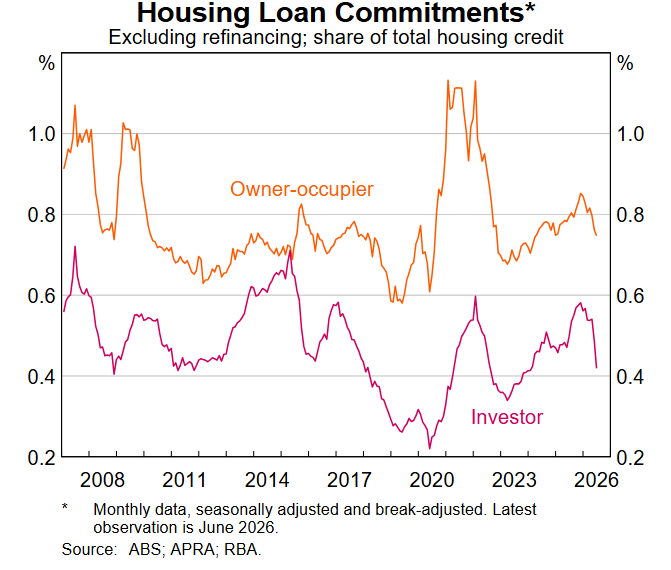
Today’s communications acknowledged that the housing market had slowed by more than expected by the RBA in May, and a sharper-than-expected correction was cited as a possible downside risk to both growth and inflation. The RBA included a chart in the SoMP which shows monthly housing loan commitments as a share of total housing credit through to June 2026; the investor share has dropped from ~0.6% to ~0.4%, one of the sharper falls in the last two decades (see Chart 4).
Still, there are a number of comments in the Statement and SoMP which suggest the Board remains relatively even-handed in its assessment of the economy. Softer labour market outcomes in Q2 are characterised as “…a temporary easing in hiring in the early stages of the Middle East conflict rather than a materially weaker-than-expected outlook over the forecast period” and growth in business debt and investment is described as “strong”. Inflation risks are “…judged to be skewed to the upside” and capacity pressures remain.
Nonetheless, the Board now appears to be a little more confident that overall financial conditions are “somewhat restrictive” and judges that “…conditions remain restrictive enough to keep growth below potential and for the labour market to ease gradually.” If inflation declines as expected, real short rates will rise in coming quarters, adding to tighter financial conditions at the margin. We think this outlook is consistent with the RBA on hold for the remainder of 2026, but we also acknowledge that it is likely to be sometime before the RBA signals greater comfort with the inflation outlook.
RBA SoMP Forecasts
Forecast revisions in the updated Statement on Monetary Policy saw relatively small changes for growth and underlying inflation, though the unemployment track has been revised higher (see charts below):
- On inflation, the trimmed mean forecasts have been revised slightly lower in the near-term but underlying inflation is still expected to remain above the top of the target band until mid-2027, before approaching the mid-point at end 2027 then settling around 2.4% through 2028.
- On GDP growth, the near-term forecast is largely unchanged with the RBA expecting GDP growth of 1.4% over 2026 (was 1.3%) but a slightly stronger outcome for 2027 at 1.6% and 1.8% for 2028.
- The unemployment rate forecast has been revised up in the near-term owing to a higher starting point – with the track around 0.2ppts higher through H2 2026 and H1 2027 and 0.1ppts higher through the back end of the forecast horizon than the May forecasts. The RBA sees the unemployment rate reaching 4.8% by mid-2028.
Overall, the forecasts continue to embody a three-year period of below trend growth which sees further loosening in the labour market (albeit with a forecast that sees the unemployment rate peaking for the cycle around 0.4ppts below its pre-pandemic rate) and wage growth gradually easing to just below 3%. In line with the statement that ongoing “subdued growth” will be required to bring inflation back to target, the forecasts also assume some opening up of a negative output gap (i.e. space capacity in the economy) in order to bring inflation back to the middle of the target range by late 2027. This appears to be a change from the framing of earlier forecast sets in 2026, where a return to a flat output gap was viewed as sufficient to bring inflation back to target.
In terms of technical assumptions, the forecasts are conditioned on a peak cash rate of 4.5% in mid-2027 (15bps of further tightening) and for the oil price to end the year just above US$80/bbl before moderating to around US$70/bbl over the next two years.
Chart 1: Trimmed Mean Inflation forecasts
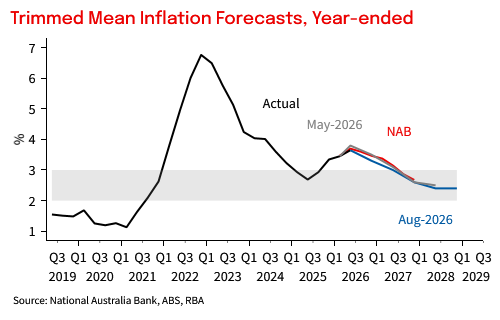
Chart 2: GDP forecasts
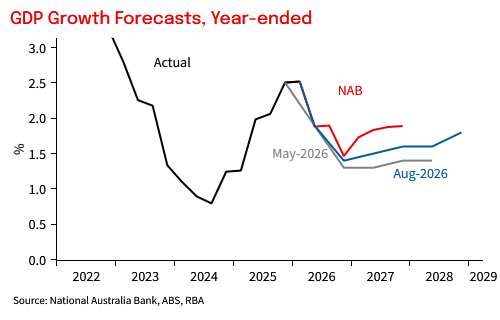
Chart 3: Unemployment forecasts
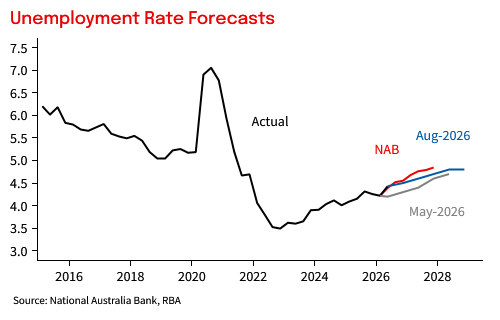
Chart 4: Housing Loan Commitments
This document has been prepared by National Australia Bank Limited ABN 12 004 044 937 AFSL 230686 ("NAB"). Any advice contained in this document has been prepared without taking into account your objectives, financial situation or needs. Before acting on any advice in this document, NAB recommends that you consider whether the advice is appropriate for your circumstances. NAB recommends that you obtain and consider the relevant Product Disclosure Statement or other disclosure document, before making any decision about a product including whether to acquire or to continue to hold it. Please Click Here to view our disclaimer and terms of use. Please Click Here to view our NAB Financial Services Guide.
All prices and analysis at 11 August 2026. This information has been prepared by National Australia Bank Limited ABN 12 004 044 937 AFSL 230686 ("NAB"). The content is distributed by WealthHub Securities Limited (WSL) (ABN 83 089 718 249)(AFSL No. 230704). WSL is a Market Participant under the ASIC Market Integrity Rules and a wholly owned subsidiary of National Australia Bank Limited (ABN 12 004 044 937)(AFSL No. 230686) (NAB). NAB doesn’t guarantee its subsidiaries’ obligations or performance, or the products or services its subsidiaries offer. This material is intended to provide general advice only. It has been prepared without having regard to or taking into account any particular investor’s objectives, financial situation and/or needs. All investors should therefore consider the appropriateness of the advice, in light of their own objectives, financial situation and/or needs, before acting on the advice. Past performance is not a reliable indicator of future performance. Any comments, suggestions or views presented do not reflect the views of WSL and/or NAB. Subject to any terms implied by law and which cannot be excluded, neither WSL nor NAB shall be liable for any errors, omissions, defects or misrepresentations in the information or general advice including any third party sourced data (including by reasons of negligence, negligent misstatement or otherwise) or for any loss or damage (whether direct or indirect) suffered by persons who use or rely on the general advice or information. If any law prohibits the exclusion of such liability, WSL and NAB limit its liability to the re-supply of the information, provided that such limitation is permitted by law and is fair and reasonable. For more information, please click here.