


Reporting Season: Welcome to the Minefield
Henry Jennings | Marcus Today
We are now entering one of the most dangerous times of the year for investors: reporting season.
Over the years, reporting season has become akin to picking your way across a minefield blindfolded. It is never easy, and one wrong step can blow up your portfolio. This August reporting season arrives against a backdrop of uncertainty, which will only add to the volatility.
Some companies will soar on the back of better-than-expected results, whilst others that merely meet expectations but disappoint on guidance or utter one negative word in the outlook statement will be smashed. Markets have become increasingly gamified in recent years. Hedge funds and trading pods are constantly searching for weakness and are more than willing to exploit it aggressively.
It does not take much to trigger an avalanche of selling, creating a cascading stop-loss event where even blue-chip stocks are not immune. In the small and mid-cap space, the situation is even more acute, where liquidity can determine a company's short-term fate. Trying to influence the share price of BHP is considerably harder than pushing a stock such as DRO sharply higher or lower.
Investing in smaller-cap companies has always carried greater risk. Part of that comes from limited broker research coverage and part from liquidity issues.
When we talk about liquidity, we are not referring to retail investors buying or selling. With a little patience, they can usually get their orders filled. The real issue arises when an institution already on the register, or one looking to get on it, decides to buy or sell. In a thin market, that can have a dramatic impact on the share price. That is why many investors avoid companies with a very small free float or where founders still own a substantial proportion of the stock, leaving relatively little available for trading.
One positive heading into this reporting season is that expectations are remarkably low. We are not expecting much, rather like my parents felt at the end of each school year when my report card arrived.

Unlike the US market, where lofty expectations remain embedded in valuations, the Australian market is starting from a much lower base. Whatever earnings growth there is will probably come from the resource sector. Fortunately, resource companies have already reported quarterly production numbers, giving investors a good handle on volumes, costs and the commodity price environment. In many cases, it is simply a matter of plugging those numbers into a spreadsheet and estimating the result.
As always, though, investors will be focusing on three key areas:
- Capital expenditure plans.
- Dividends and potential buybacks.
- Forward guidance.
There are also a handful of stocks that will provide valuable insights into broader market trends. Some are perennial retail favourites, including Commonwealth Bank (CBA), Electro Optics Systems (EOS) and, in the resources sector, Pilbara Minerals (PLS). The healthcare heavyweights CSL and COH will also be firmly in the spotlight. They remain classic "forever stocks" for many retail investors, and expectations remain high. Having been casualties in previous seasons, investors will need to see some turnaround.
Source: Marcus Today
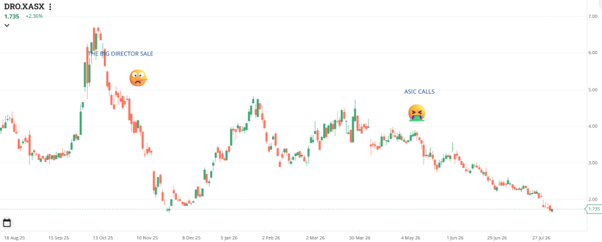
One company that always captures retail attention is DroneShield(DRO), although it has been a disappointing performer over recent months. Much of the weakness began after the former CEO and several directors sold significant holdings at substantially higher prices. That proved to be the catalyst for an ASIC investigation into trading in the stock, which remains ongoing.
More recently, the company released a first-half trading update and CY26 revenue guidance. First-half revenue is expected to be around $125.8m, representing growth of 74% year on year. As always with DRO, however, the key issue is converting its impressive sales pipeline into actual revenue. Something that has disappointed, together with the margins under some pressure.
The recent FIFA World Cup highlighted both the opportunity and the challenge. DroneShield provided the primary drone detection layer for Kansas City but secured only one contract out of 11 states and around US$325m of available spending. Competition is also intensifying. AVAV recently secured a significant order for its Titan family of products, demonstrating that DRO is no longer the only game in town.
The US remains DroneShield's largest market opportunity, but Europe continues to underpin its actual growth and now accounts for around half of the company's sales pipeline. Breaking into the US market is a significant way is always a tantalising prospect, but it is not easy.
The war in Ukraine has undoubtedly shone a spotlight on drones and counter-drone technology, a theme that DRO has benefited from enormously. But it is well and truly fallen from grace after the CEOs share sale. We have a new CEO at the helm, but has so far failed to inspire any stability in the share price.
Once one of the market's highest-flying growth stocks, DRO now has a short position approaching 15%. At present, the hedge funds appear to have the upper hand. As the share price has fallen, the short interest has continued to build.
Although investors have a reasonable handle on current trading following the July update, further developments in the ASIC investigation could easily become the next catalyst, either positive or negative. Highly shorted stocks are inherently volatile and can stage spectacular short squeezes on even modest pieces of good news.
The other key issue remains the sales pipeline, which appears to have softened in recent updates. Coupled with increasing competition in the US and missed opportunities around the World Cup contracts, there are legitimate questions that management will need to answer.
- DRO is certainly not the only small or mid-cap stock likely to experience outsized moves this reporting season.
- EOS continues to operate in a similar defence technology space but has arguably done a better job converting opportunities into revenue.
- 4DX has also been an outstanding performer, and investors will be keen to see whether its operational momentum continues.
The market is taking no prisoners. This is the stage of the cycle where companies need to deliver revenue, cash flow and earnings, not simply hope and promises. Those days are over.
As the old saying goes, hope doesn't butter no parsnips. Good luck out there this August. Tread carefully.
A free trial of the Marcus Today newsletter for nabtrade clients is available here.
All prices and analysis at 3 August 2026. This information has been prepared by Marcus Today Pty Limited. Marcus Today Pty Ltd ABN 57 110 971 689 is a Corporate Authorised Representative (no. 310093) of AdviceNet Pty Ltd ABN 35 122 720 512 (AFSL 308200). The content is distributed by WealthHub Securities Limited (WSL) (ABN 83 089 718 249)(AFSL No. 230704). WSL is a Market Participant under the ASIC Market Integrity Rules and a wholly owned subsidiary of National Australia Bank Limited (ABN 12 004 044 937)(AFSL No. 230686) (NAB). NAB doesn’t guarantee its subsidiaries’ obligations or performance, or the products or services its subsidiaries offer. This material is intended to provide general advice only. It has been prepared without having regard to or taking into account any particular investor’s objectives, financial situation and/or needs. All investors should therefore consider the appropriateness of the advice, in light of their own objectives, financial situation and/or needs, before acting on the advice. Past performance is not a reliable indicator of future performance. Any comments, suggestions or views presented do not reflect the views of WSL and/or NAB. Subject to any terms implied by law and which cannot be excluded, neither WSL nor NAB shall be liable for any errors, omissions, defects or misrepresentations in the information or general advice including any third party sourced data (including by reasons of negligence, negligent misstatement or otherwise) or for any loss or damage (whether direct or indirect) suffered by persons who use or rely on the general advice or information. If any law prohibits the exclusion of such liability, WSL and NAB limit its liability to the re-supply of the information, provided that such limitation is permitted by law and is fair and reasonable. For more information, please click here.