


RBA hikes 25bps as expected
Sally Auld | Chief Economist & Taylor Nugent | Senior Economist
Key points
- The RBA increased the cash rate by 25bps to 4.85%, as expected.
- The decision was not unanimous, with three Board members voting against the decision to lift interest rates.
- With policy restrictive, we forecast the RBA on hold. However, the RBA will remain very sensitive to any upside surprise in inflation in coming months.
Outcome and Assessment
The broader Statement reads as hawkish. Inflation is described as “broad based”, there is less capacity in the economy than was estimated just three months ago, and there is evidence of pass through of higher fuel prices. The Board has noted “…an increasing risk that higher inflation expectations will become embedded.” Revisions to the core inflation forecast are material (30bps to year ended rates through to end 2027).
However, there were a couple of developments that temper the hawkishness. First, there were three dissents to today’s decision. This is only the fourth time that the decision of the Monetary Policy Board has not been unanimous, and we learnt in the press conference that this was not an argument around timing, but rather about different weighting given to upside risks to inflation vs. downside risks to growth. Second, unlike the prior month, where the Statement noted that “The Board will continue to do what it considers necessary to bring inflation sustainably back to target, including increasing the cash rate target further if needed”, the second part of this sentence was omitted in November. Third, the commentary on the domestic economy appears more willing to acknowledge recent developments on the activity side, including the line that “The economy is slowing, housing prices have fallen significantly and the unemployment rate has risen.”
We think that the Board are now likely comfortable with the assessment that monetary policy is in restrictive territory. The spread between the current cash rate and the average neutral rate of the RBA’s eight models is ~145bps. This is one of the highest spreads in 30 years, excluding the pre GFC tightening cycle. Moreover, looking at GDP and employment growth forecasts for end-2027, we think the bar is low for disappointment (that is, risks look biased to the downside to the RBA’s forecasts). All else equal, this set up probably argues for a near-term pause.
Possibly working in the other direction is the upward revision – albeit modest – to the staff estimate of NAIRU. This is now pegged at 4.75%, which resets the estimation of spare capacity in the labour market. Forecasting the unemployment rate to peak at 5.1% in 2028 should – on our analysis – be just enough to achieve inflation outcomes consistent with the midpoint of the target band. But it leaves little room for error and does imply a “Goldilocks” disinflation, especially considering the RBA’s hawkish description of the inflation challenge at present. While we are not forecasting further policy tightening from here, there is little doubt the RBA will be sensitive (and responsive) to any upside surprise in inflation in coming months.
RBA SoMP Forecasts
Forecast revisions in the updated Statement on Monetary Policy show slower growth and higher unemployment. Higher inflation in the near term reflects stronger recent outcomes and a higher fuel assumption, but further out revisions are minimal, as higher unemployment is offset by a modest reassessment of domestic capacity pressures.
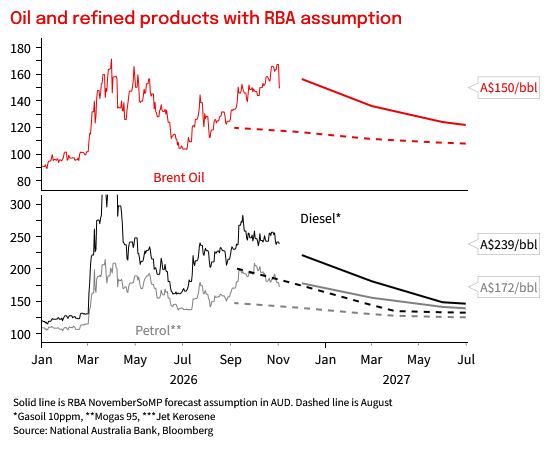
Since the August SoMP, unemployment is tracking around 2 tenths higher than forecast, and Q3 trimmed mean was almost 2 tenths stronger than forecast. The oil assumption for Q4 has been revised 35% higher, and the forecasts are conditioned on a path for the cash rate that peaks at 4.9%, ~40bp above the August assumption.
- On inflation, near-term headline inflation has been revised up sharply to reflect higher fuel prices (4.5% over 2026, from 3.6%). Trimmed mean has also been revised higher, ending 2026 at 3.6% (from 3.3%), and cooling to 2.9% over 2027 (from 2.6%), but still reaching 2.4% over 2028 (from 2.4%).
- On GDP growth, the near-term forecast has been revised a little higher, to 1.6% over 2026 (from 1.4%). Growth slows to 1.3% over 2027 (from 1.6%) and 1.5% over 2028 (from 1.8%), reflecting a larger drag from tighter monetary policy, the weaker housing market, and higher headline inflation.
- The unemployment rate forecast has been revised up, owing to a higher starting point, but it is still expected to rise only very gradually. Unemployment is now seen at 4.7% in Q4 (from 4.5%), rising steadily to 5.1% at end 2028 (from 4.8%). However, this is framed as consistent with reaching balance next year before spare capacity emerges. That is similar to the characterisation in August.
Chart 1: Trimmed Mean Inflation forecasts
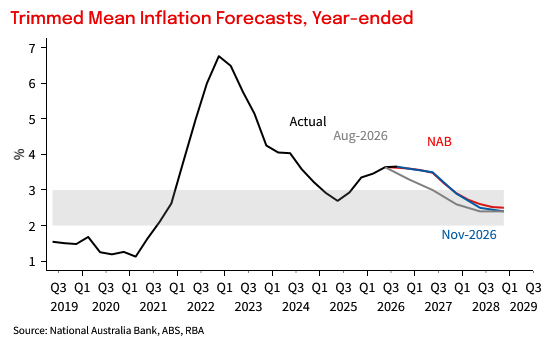
Chart 2: GDP forecasts
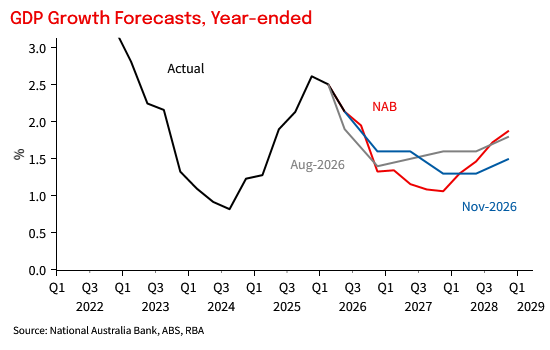
Chart 3: Unemployment forecasts
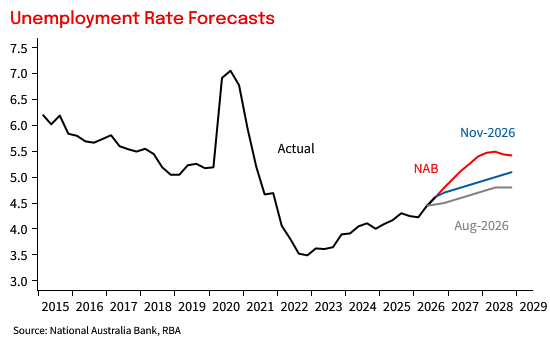
Chart 4: RBA energy assumptions
This document has been prepared by National Australia Bank Limited ABN 12 004 044 937 AFSL 230686 ("NAB"). Any advice contained in this document has been prepared without taking into account your objectives, financial situation or needs. Before acting on any advice in this document, NAB recommends that you consider whether the advice is appropriate for your circumstances. NAB recommends that you obtain and consider the relevant Product Disclosure Statement or other disclosure document, before making any decision about a product including whether to acquire or to continue to hold it. Please Click Here to view our disclaimer and terms of use. Please Click Here to view our NAB Financial Services Guide.
All prices and analysis at 3 November 2026. This information has been prepared by National Australia Bank Limited ABN 12 004 044 937 AFSL 230686 ("NAB"). The content is distributed by WealthHub Securities Limited (WSL) (ABN 83 089 718 249)(AFSL No. 230704). WSL is a Market Participant under the ASIC Market Integrity Rules and a wholly owned subsidiary of National Australia Bank Limited (ABN 12 004 044 937)(AFSL No. 230686) (NAB). NAB doesn’t guarantee its subsidiaries’ obligations or performance, or the products or services its subsidiaries offer. This material is intended to provide general advice only. It has been prepared without having regard to or taking into account any particular investor’s objectives, financial situation and/or needs. All investors should therefore consider the appropriateness of the advice, in light of their own objectives, financial situation and/or needs, before acting on the advice. Past performance is not a reliable indicator of future performance. Any comments, suggestions or views presented do not reflect the views of WSL and/or NAB. Subject to any terms implied by law and which cannot be excluded, neither WSL nor NAB shall be liable for any errors, omissions, defects or misrepresentations in the information or general advice including any third party sourced data (including by reasons of negligence, negligent misstatement or otherwise) or for any loss or damage (whether direct or indirect) suffered by persons who use or rely on the general advice or information. If any law prohibits the exclusion of such liability, WSL and NAB limit its liability to the re-supply of the information, provided that such limitation is permitted by law and is fair and reasonable. For more information, please click here