


Why your SMSF must have a retirement income strategy
Everyone needs to rethink what income means in retirement. That's the message from the Government, and it will soon impose obligations on all super funds, including SMSFs, to provide a plan to maximise retirement income.
The Government is imposing a definition which every super member needs to understand. In future, it will guide retirement spending policies and determine how super funds communicate with their members.
While a common definition of income is "money that is earned from doing work or received from investments" (Cambridge English Dictionary), add the word 'retirement' and 'retirement income' becomes:
- withdrawals from super
- age pension
- drawdown of non-super assets.
Yes, enter your retirement and draw $5,000 from a bank account to go on a holiday, and that's retirement income. Get used to it.
The impact of the Retirement Income Covenant on SMSFs
The argument that retirees should draw income from any of their assets, including their family home, has been taken further in the newly-released Retirement Income Covenant position paper, effective from 1 July 2022. It requires every super fund to provide a document:
“… outlining their plan to assist their members to achieve and balance the following objectives:
1. maximise their retirement income
2. manage risks to the sustainability and stability of their retirement income; and
3. have some flexible access to savings during retirement."
Generating a retirement income without taking risk is more difficult now than in prior years. A comfortable standard of living for a couple in retirement at age 65 according to Association of Superannuation Funds of Australia (ASFA) requires $62,828 a year, assuming home ownership. If they have investible assets of $1 million and they do not want to spend their capital, that means an income of 6.28% is required. That's a big ask these days without a fair amount of equity-type risk in a portfolio, which is where the drawdown of capital comes in.
There are many views on a safe annual withdrawal rate for a retiree not to run out of money. Traditionally, 4% was considered appropriate, but as interest rates have fallen, many people argue for 3% or less. This is not much to live on. Drawing 2.5% on $1 million is only $25,000, and there is no magic riskless return in investment markets. The Government will require trustees to educate their members about using their capital.
The Covenant draws on the Retirement Income Review in making the case to retirees:
“Partly because they have only ever been primed to save as large a lump sum as possible, retirees struggle with the concept that superannuation is to be consumed to fund their retirement. Because retirees struggle to develop effective retirement income strategies on their own, much of the savings accrued by members through the superannuation system are not used to provide retirement income. Rather, they remain unspent and become part of the person’s bequest when they die.
Multiple studies have shown that retirees die with around 90% of the assets they had at retirement. Without a change in behaviour, it is expected that bequests from superannuation will grow. By 2060, it is projected that 1 in every 3 dollars paid out of the superannuation system will be a part of a bequest.”
This claim that "... retirees die with around 90% of the assets they had at retirement" is in contrast to arguments by Ross Clare, Director Research at ASFA who wrote an article in Firstlinks called "In fact, most people have no super when they die".
Just in case SMSF trustees think the deliberations are only for the consultants, professional fund managers and trustees of large funds, the Government makes it clear that SMSF trustees have obligations as well. It says:
“Trustees of SMSFs and SAFs (Small APRA Funds) with retired members should have a retirement income strategy... (they) are not expected to develop their strategy for cohorts of their members, given their small size. However, if trustees of SMSFs and SAFs identify that their members need markedly different approaches to balance the objectives under the strategy, they are not precluded from developing their strategy for cohorts of their members.”
The Covenant provides few clues
For all its arguments about the benefits of providing members with retirement products tailored to their needs, the Covenant provides few hints on how to achieve the outcome. It includes hopeful statements such as:
“... the strategy should identify how trustees intend to assist their members to balance these objectives and whether the trustee’s intended assistance is likely to increase or decrease the retirement incomes of their members.”
Or this gem that reads as if from an undergraduate economics exam where the strategy is a strategic document (sic):
“In effect, the strategy is a strategic document developed by the trustee that:
1. identifies and recognises the retirement income needs of the members of the fund; and
2. presents a plan to build the fund’s capacity and capability to service those needs.”
There is even doubt about whether the Covenant is possible to implement under current regulations. Dr Pamela Hanrahan recently told a Conexus Institute webinar that trustees are limited in their ability to provide tailored advice for members, and the Covenant probably falls foul of the distinction between general and personal financial advice.
The Government’s own policies on drawdowns are confusing. At the same time as they are advocating retirees spend their capital, they reduced the mandatory minimum amount required to be withdrawn from a pension account by 50%. Initially, this was due to the pandemic, but it was recently extended for another year after the market had strongly recovered.
Not much merit in having a Retirement Income Review and now a Covenant arguing retirees should take money out when the Government then says leave it in.
Complicating matters, at a time when the risk-free bond rate is close to 1% and stockmarkets are at all-time highs and expensive by most standards, trustees cannot simply offer promises of attractive investment returns to satisfy retirement income needs.
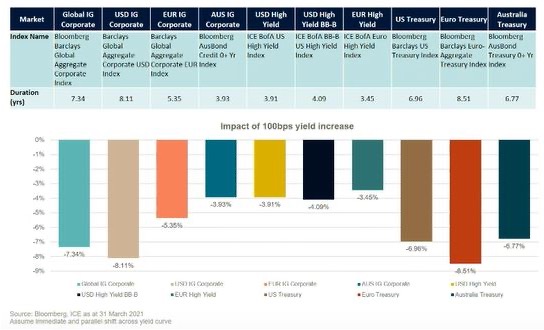
For example, consider this chart, provided by First Sentier Investors, which shows the capital loss from a 1% rise in rates, on a range of bond indexes. Bonds are supposed to protect investor portfolios in times of distress. For example, in Australia, the government bond index has a duration of 6.8 years, meaning a 6.8% loss for a 1% rate rise. SMSFs and other funds cannot rely on the past successes in the way a simple 60/40 portfolio delivered handsomely in a retirement.
SMSF trustees need to develop a retirement strategy document
Most people probably believe income and capital are different. If someone invests $100,000 and earns $2,500, this represents their ‘income’. If they drawdown ‘income’ of $10,000 from an account (super or not) but their capital is now $92,500, few people will call this $10,000 of income.
The Government, however, argues any asset owned by a retiree, including their home, should be form part of a retirement income strategy. The Covenant instructions create new obligations for trustees of SMSFs:
"Trustees should regularly and comprehensively review the appropriateness, effectiveness and
adequacy of their retirement income strategy including the assumptions underpinning it, every three years at a minimum ... the review of the retirement income strategy will be required to be undertaken by operationally independent, appropriately trained, and competent persons.”
Each SMSF will have unique needs and solutions, and all SMSF trustees must now design a retirement income strategy to meet the new requirements.