


These two ASX-listed stocks failed our corporate BS test
Marcus Howes | Plato Investment Management
In May 2018, Elon Musk hosted what several analysts called one of the strangest earnings calls they had ever heard. Partway through Tesla’s first-quarter call, he cut off a Bernstein analyst with “boring, bonehead questions are not cool,” handed the floor to a retail investor on YouTube, and told the market to “please sell our stock.”
Asked about Tesla’s moat, he said “moats are lame.”
The quarterly loss was narrower than Wall Street feared. The stock fell more than 5 per cent anyway. What spooked the market was not the loss. It was the dodging.
This is an extreme example - you didn’t need an algorithm to work it out. The trouble is most executives are well-trained in the art of evasion.
With ASX reporting season almost here, it’s a good time to highlight one of Plato’s red flag tools that we’ll be monitoring closely as earnings call transcripts are released.
Teaching a machine to listen
Over the past 3 years, our quantitative analytics team has been refining what in its simplest form can be described as a corporate BS detector. Using Natural Language Processing (NLP), our proprietary systems are now adept at detecting evasion during earnings calls.
We ingest every available earnings call, isolating the unscripted Q&A segment, where prepared remarks give way to live Q&A. From every response, language vectors are extracted to detect the following three factors.
- Q&A divergence (is the response to the question off topic)
- Length of answer to question ratio (where a simple question gets a long-winded answer)
- High proportion of forward-tense in answers
The first of these is where large language models, the same kind of AI behind today’s chatbots, do the work: we use them to measure how closely each answer stays on topic with the question asked. All three measures capture whether management is engaging with what it is being asked or simply managing the room.
If all three of the above signals fire, a composite red flag is activated.
For those unfamiliar with our red flags risk management framework, we find companies with 8 or more red flags underperform the market by around 20% over the proceeding 12-month period.
The system now includes over 150 red flags ranging from this language detector, to accounting practices, executive backgrounds, balance sheet items, and social and governance factors.
NPL case studies
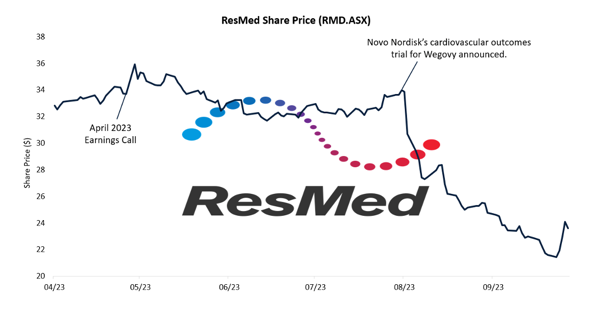
Wind back to ResMed’s April 2023 earnings call. Revenue up 29 per cent, device sales up more than 40 per cent. The market loved it on the day.
Near the end, a Goldman Sachs analyst asked a short and direct question that mattered: could weight-loss drugs like Ozempic shrink ResMed’s market?
The answer ran to roughly 470 words. It opened by recasting the threat as “a huge market and actually quite exciting.” It detoured through a 23-year-old anecdote about bariatric surgery, then promised that “we’re going to partner with pharma in this space.”
What it never did was answer the question: could the addressable market shrink?
A seven-to-one answer-to-question ratio, three pivots into the future tense, and the core of the question left unanswered. It wasn’t a one-off: a profit margin query drew four “I’m bullish” responses, but no timeframe.
Source: Plato
Plato was underweight ResMed at the time. On top of six other red flags, run our evasion signal over this call, and it lights up on its own.
On 8 August 2023, Novo Nordisk released the headline results of its SELECT trial: semaglutide, sold as Wegovy, cut major cardiovascular events by 20 per cent. The GLP-1 story was no longer only about weight loss. ResMed shares, already sliding, fell by around a third.
The April numbers were excellent, but the non-answer was the tell.
Notably, the stock recovered over the following year as the GLP-1 fears proved overstated, and it remains a successful, well-run company today. But in this case, the signal flagged the incoming shorter-term sentiment shift that would surround the company.
More recently in February, Smart Parking (ASX: SPZ) reported a record half: revenue up 96%, EBITDA up 85%. Yet almost every question circled the same doubt: how much of it was real?
It leaned on an acquisition and a one-off-looking surge in debt recovery, while underlying UK volumes were flat, and profit margins slipped.
Asked about reputational risk, a looming UK price cap, and the quality of its debt book, the CEO reframed each rather than answering. Our signal flagged the call, and evasion was one of six red flags which led to a short position in the Plato Global Alpha Fund. The stock fell over 30 per cent in the next three months.
The whole is greater than the sum of the parts
None of this is about catching anyone in a lie. Companies evade for ordinary reasons: they don’t know, they can’t say, they’d rather change the subject. But evasion is information, and it clusters around exactly the questions that matter most.
A person listening live forgives a confident dodge. A systematic process does not: it scores every exchange the same way, with no charisma in the room and no benefit of the doubt.
It’s important to emphasise questions evasion alone doesn’t mean a company is a bad investment – there are many variables to consider when it comes to why question evasion might be flagged.
However, when it corresponds with numerous other red flags, the whole is much greater than the sum of the parts.
The Plato Global Alpha Fund is a long/short global equities strategy that has delivered +24.5% p.a. after fees since inception (1 Sept 2021). The fund is accessible on the ASX via the Plato Global Alpha Complex ETF (ASX: PGA1).
Learn how the industry leaders are navigating today's market every morning at 6am. Access Livewire Markets Today.
All prices and analysis at 16 July 2026. This document was originally published in Livewire Markets on 16 July 2026. This information has been prepared Plato Investment Management Limited (‘Plato’) (ABN 77 120 730 136, AFSL 504616). The content is distributed by WealthHub Securities Limited (WSL) (ABN 83 089 718 249)(AFSL No. 230704). WSL is a Market Participant under the ASIC Market Integrity Rules and a wholly owned subsidiary of National Australia Bank Limited (ABN 12 004 044 937)(AFSL No. 230686) (NAB). NAB doesn’t guarantee its subsidiaries’ obligations or performance, or the products or services its subsidiaries offer. This material is intended to provide general advice only. It has been prepared without having regard to or taking into account any particular investor’s objectives, financial situation and/or needs. All investors should therefore consider the appropriateness of the advice, in light of their own objectives, financial situation and/or needs, before acting on the advice. Past performance is not a reliable indicator of future performance. Any comments, suggestions or views presented do not reflect the views of WSL and/or NAB. Subject to any terms implied by law and which cannot be excluded, neither WSL nor NAB shall be liable for any errors, omissions, defects or misrepresentations in the information or general advice including any third party sourced data (including by reasons of negligence, negligent misstatement or otherwise) or for any loss or damage (whether direct or indirect) suffered by persons who use or rely on the general advice or information. If any law prohibits the exclusion of such liability, WSL and NAB limit its liability to the re-supply of the information, provided that such limitation is permitted by law and is fair and reasonable. For more information, please click here.