


The fine line between mistake and opportunity
Simon Mawhinney | Allan Gray
Performance has been very strong recently, with 71% of your capital invested in winning positions in the Allan Gray Australia Equity strategy portfolio over the last year to 31 August 2026.
During the recent August reporting season, the Allan Gray Australia Equity Fund (Class A) (which is generally representative of the Allan Gray Australia Equity strategy) outperformed the S&P/ASX 300 Index by 4.8% for that month.
Despite this, our success ratio (the ratio of outperforming stocks relative to total stocks held) has fallen to 59%, below our since-public-launch average of 62%. You can see this in Table 1.
Table 1 - Performance attribution (%) of the Allan Gray Australia Equity Fund (Class A)
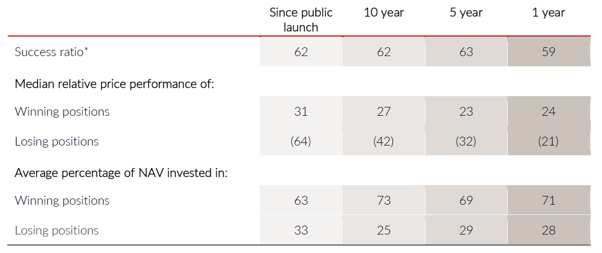
* The ratio of outperforming or winning stocks relative to total stock positions for the period. Winning and losing stocks are calculated on their performance relative to the S&P/ASX 300 Accumulation Index. Source: Allan Gray Australia, 31 August 2026. The Allan Gray Australia Equity Fund (Class A) portfolio is generally representative of the Allan Gray Australia Equity strategy, which includes institutional mandates. Past performance is not a reliable indicator of future performance.
41% of the Fund’s holdings were still losers! There aren’t many professions out there that would tolerate a failure rate this high so it is fair to ask whether we should. The answer is complicated.
We will always make mistakes: one can’t swing a bat without missing a few balls, and trying to solve for a ‘no mistakes’ outcome is not practical. It would involve not swinging the bat at all – the fastest route to mediocrity. We’d simply own the index: there would be no relative failures, but there would be no successes either.
That’s not to say we shouldn’t do anything about our failures. We need to learn from these mistakes, ensure that we remain grounded in the fundamentals and that emotions and bias remain absent from our capital allocation decisions. Small increases in our success ratio can have very powerful effects on client capital over the long term.
It is in this vein that we discuss Endeavour Group Limited (ASX: EDV) in this quarterly report. Endeavour Group’s total return over the past year to 23 September 2026 has been -15%, putting it squarely in the losing category. Before discussing some mistakes in our thesis and what we’ve done about them, a brief overview of the company is necessary.
What does Endeavour Group do?
Endeavour Group is a liquor retailer and hotel (pub) operator in Australia. It was spun out of Woolworths in 2021 and owns 288 Dan Murphy’s stores (a large-format liquor retailer), 1,451 BWS stores (a convenience liquor retailer), and 351 licensed hospitality venues (pubs and hotels offering electronic gaming, food, drinks, and some accommodation). The vast majority of its operating footprint (refer to Figure 1) is leased.
Figure 1 - Endeavour’s operations by location
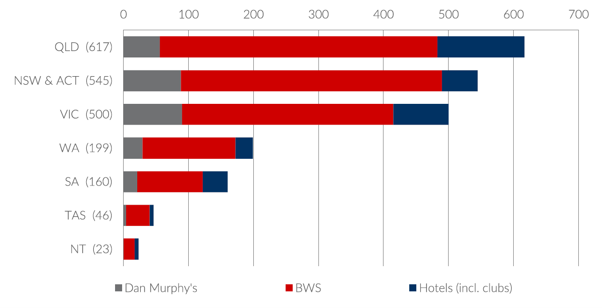
Source: Endeavour Group Limited, 28 June 2026.
Our first foray
We first bought Endeavour in late 2024 after its share price had fallen from a peak of over $8 per share in 2022 to around $4.50 per share. At the time, liquor retailing was suffering from a combination of difficulties: structural changes in alcohol consumption patterns, cyclical cost-of-living headwinds following the COVID-19 pandemic-era boost to at-home spending and a loss of some market share.
Victoria’s electronic gaming machine (EGM) reforms announced in July 2023 also contributed to share price weakness, as the investment community fretted about their impact and the likelihood that similar reforms would be adopted across Australia. We felt that the share price had overreacted and began patiently accumulating a position. Even allowing for a meaningful hit from tougher EGM rules, the business appeared cheap for a company with strong market positions (roughly 40% of Australia’s liquor retail market).
Endeavour’s share price has fallen around 30% since our first investments, while the S&P/ASX 300 Index has risen modestly. It has been a much tougher few years than we expected in the liquor retail business and the decent performance of Endeavour’s hotel business has been nowhere near enough to offset this. Earnings before interest and taxes (EBIT) margins (inclusive of all lease costs) in the liquor retail business have fallen from a consistent 6% over the available history since 2015 to around 4% for the 2026 financial year (FY26) (as shown in Graph 1), as competitive intensity increased and softer consumer demand bit harder than we anticipated.
Graph 1 - Endeavour Group’s EBIT margins
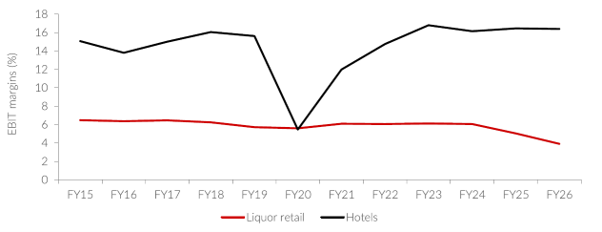
Source: Endeavour Group and Woolworths Group disclosures; Allan Gray estimates, September 2026. Note: All EBIT margins are stated pre-AASB16, an Australian accounting standard meaning they are inclusive of all lease costs, and are pre-unallocated costs, which are costs related to various group support functions including corporate costs.
Were we wrong?
At best, we were too early with our initial Endeavour investment. This is no different to being wrong, and many of the risks that existed at the time of our initial investment remain risks today. If anything, cost-of-living pressures have worsened, the health concerns surrounding alcohol consumption are unlikely to reverse, and competition from the likes of Amazon remains a force to be reckoned with in the Australian retail landscape over the long term. Simultaneously, embedded inflation (for example, in rents and employee costs) continues to increase Endeavour’s cost of doing business.
The combined impact of these creates a formidable headwind for Endeavour.
There are also other new concerns. Endeavour has significantly accelerated its hotel renewal programme, with 60-75 renewals planned for 2027 (up from 38 in 2026 and 25 in 2024). Hotels don’t come cheap and largely account for the jump in Endeavour’s forecast capital expenditure spend of up to $650 million (m) in 2027, almost 50% higher than 2026’s already high figure. It is unlikely that Endeavour will generate any free cash flow in 2027, and its dividend may prove to be both generous and debt-funded!
Sell, sell, sell?
Before joining the stampede towards the exit, we believe there are at least some reasons for optimism. The first of these is the share price fall since our initial investment. As at 23 September 2026, Endeavour trades at roughly 17 times next year’s forecast earnings. This is close to 10% lower than the S&P/ASX 300 Index’s multiple and Endeavour’s earnings themselves are far more depressed (relative to its historical earnings) than the index’s. Consensus forecasts for Endeavour’s earnings in 2027 are 36% below its 2022 earnings.
Comparing Endeavour’s earnings to the market’s is meaningless if the company’s revenue, and therefore earnings, are in structural decline (while the broader share market’s are not!). While we can’t rule this out, even if this were the case, its effects can’t be assessed in a vacuum. For example, there would most likely be a competitive response, and we are already seeing evidence of it.
Endeavour’s main liquor retail rival, Coles, has seen its total (convenience plus large format) liquor retail profit margins (including all lease costs) decline from around 4% historically to about 1% now. Given the capital required in liquor retailing (e.g. inventory), a 1% Coles liquor margin would likely mean a paltry return on invested capital. Coles’ large-format liquor retail revenue declined by about 15-20% in FY26, implying they were likely unprofitable in aggregate, with Coles planning to close some of them in FY27. Dan Murphy’s should attract a decent proportion of Coles’ lost sales.
The largely Metcash-supplied ‘independents’ may not be faring any better than Coles. In a recent trading update for the first 18 weeks of their FY27, Metcash reported that liquor sales to independent liquor retailers (and contract customers) were flat compared with last year. After taking inflation into account, volumes are likely declining and, like Endeavour, costs would be rising.
Regarding EGM reform, state governments mostly appear to be adopting a more pragmatic stance than feared, perhaps due to reliance on gaming revenue taxes and reluctance to harm registered clubs. Facial recognition and automated risk monitoring could win out over more extreme measures (e.g. EGM phase-outs, flat taxes on machines, mandatory cashless cards, and mandatory bet/loss limits).
And then there is self-help. Endeavour has announced $100m in expected cost savings for 2027, with 70% already executed. A further $200m of savings are expected in 2028 and 2029. Little if any of this cumulative $300m in savings will flow to Endeavour’s bottom line, but they are likely to improve Endeavour’s efficiency and ability to compete (and win?) in its markets.
The jury is still out
Further weakness in consumer demand and structural declines in alcohol consumption remain headwinds for Endeavour. Its hotel business remains skewed to EGM profits and is heavily exposed to more restrictive regulatory settings.
But handicapping the thesis solely on these risks, without considering potential tailwinds, might prove overly pessimistic. Its new CEO, Jayne Hrdlicka, seems to think so, having just purchased $1m of Endeavour shares on-market (we like to see company management ‘backing its own horse’).
Australian liquor retail profit margins are depressed, and we believe there is room for recovery over time. We believe Endeavour continues to warrant a position in the Allan Gray Australia Equity strategy portfolio.
Learn how the industry leaders are navigating today's market every morning at 6am. Access Livewire Markets Today.
All prices and analysis at 21 October 2026. This document was originally published in Livewire Markets on 21 October 2026. This information has been prepared by Allan Gray Australia Pty Ltd the ABN 48 112 316 168, AFSL number 298487. The content is distributed by WealthHub Securities Limited (WSL) (ABN 83 089 718 249)(AFSL No. 230704). WSL is a Market Participant under the ASIC Market Integrity Rules and a wholly owned subsidiary of National Australia Bank Limited (ABN 12 004 044 937)(AFSL No. 230686) (NAB). NAB doesn’t guarantee its subsidiaries’ obligations or performance, or the products or services its subsidiaries offer. This material is intended to provide general advice only. It has been prepared without having regard to or taking into account any particular investor’s objectives, financial situation and/or needs. All investors should therefore consider the appropriateness of the advice, in light of their own objectives, financial situation and/or needs, before acting on the advice. Past performance is not a reliable indicator of future performance. Any comments, suggestions or views presented do not reflect the views of WSL and/or NAB. Subject to any terms implied by law and which cannot be excluded, neither WSL nor NAB shall be liable for any errors, omissions, defects or misrepresentations in the information or general advice including any third party sourced data (including by reasons of negligence, negligent misstatement or otherwise) or for any loss or damage (whether direct or indirect) suffered by persons who use or rely on the general advice or information. If any law prohibits the exclusion of such liability, WSL and NAB limit its liability to the re-supply of the information, provided that such limitation is permitted by law and is fair and reasonable. For more information, please click here.